Choosing the “top three” insurers sounds simple until you see how many ways greatness is measured. One company may dominate assets, another may win on claims confidence, and another may feel easiest to trust when life gets expensive fast.
This quick guide turns a crowded industry into a practical shortlist. You will see who is commonly recognized near the top, why rankings shift by insurance type, and how to compare real value instead of chasing a famous name alone.




Define the Meaning of “Top Three Insurance Company”
“Top three” sounds simple, but in insurance, that label changes depending on what you value most. A giant company can dominate headlines, while a smaller rival wins loyalty through faster claims, better service, or stronger local trust.
That is why the phrase should never be treated as a single universal ranking. Insurance companies can be measured by market share, revenue, total assets, customer satisfaction, claim performance, and brand reputation. Each lens reveals a different kind of strength: size shows scale, assets suggest capacity, satisfaction reflects real customer experience, and claims results often reveal whether a company delivers when policyholders need help most.
What “Top” Really Signals
A smarter way to read any “top three” list is to ask what the ranking is actually rewarding. Big does not always mean best for every buyer, and trusted does not always mean largest on paper. The table below shows how the most common ranking factors work and why they can produce very different winners.
| Ranking Factor | What It Measures | Why It Matters | Typical Data Source |
|---|---|---|---|
| Market Share | Portion of premiums or policies controlled by an insurer | Shows scale, visibility, and competitive reach | Regulatory filings, industry reports |
| Revenue | Total income from premiums and operations | Highlights business size and sales power | Annual reports, financial statements |
| Assets | Total investments and resources held | Signals long-term capacity to meet obligations | Balance sheets, ratings agencies |
| Customer Satisfaction | How policyholders rate service and support | Reveals day-to-day experience beyond numbers | Consumer surveys, review studies |
| Claim Performance | Speed, fairness, and consistency of claims handling | Shows whether coverage works in real-life moments | Complaint ratios, claims surveys |
| Brand Reputation | Public trust, recognition, and perceived reliability | Influences buyer confidence and retention | Brand studies, media analysis |
Category also changes the scoreboard. A company that looks unbeatable in one insurance line may not even lead in another, because products, risk models, regulations, and customer expectations differ.
| Insurance Category | What Often Drives “Top” Status | Why Rankings Shift | Common Winner Type |
|---|---|---|---|
| Life | Assets, solvency, long-term stability | Policies last decades and rely on financial endurance | Large asset-heavy carriers |
| Health | Provider networks, claims systems, member experience | Access and administration matter as much as scale | National or regional specialists |
| Auto | Pricing, claims speed, digital service | High claim frequency makes service more visible | Mass-market consumer brands |
| Home | Catastrophe response, underwriting strength, complaints | Storm and disaster exposure changes performance fast | Strong regional or multiline firms |
| Multi-line | Bundling value, cross-product consistency | Buyers compare convenience across several policies | Broad national insurers |
Use this distinction to avoid being dazzled by size alone. A ranking built for investors may look very different from one built for households choosing protection.
- A globally large insurer usually excels in assets, revenue, and geographic reach.
- A nationally trusted insurer often stands out in service quality, claims satisfaction, and local brand confidence.
- Global scale can suggest resilience, but it does not guarantee the best fit for a specific market or policy type.
- National trust can be more relevant when buyers care about agent access, local regulations, or disaster response.
Pro Tip: When you see “top three,” immediately ask, “Top by what?” That one question turns a vague ranking into a useful buying filter.
Present the Most Commonly Recognized Top Three Insurance Companies
When people ask who sits in the insurance winner’s circle, the same names surface again and again. Across consumer rankings, market-share reports, and industry visibility, State Farm, Allianz, and AXA are among the most commonly recognized leaders.
They do not dominate for exactly the same reason. One is famous for mass-market reach, another for global scale, and another for broad financial protection across personal and commercial lines. Together, they form a practical “top three” that many readers will already recognize from public reports, advertising presence, and long-standing market influence.
Three Giants, Three Distinct Winning Lanes
The snapshot below highlights why these brands are so often mentioned near the top. While rankings vary by methodology, each company brings a powerful mix of brand recognition, product depth, and operational scale that keeps it in serious consideration.
| Company | Main Products | Strengths | Market Presence |
|---|---|---|---|
| State Farm | Auto, home, renters, life, small business, disability, banking add-ons | Huge agent network, strong brand familiarity, broad personal-line coverage | Founded in 1922 in the U.S.; strongest in the United States with a massive middle-market customer base |
| Allianz | Life, health, travel, asset protection, commercial, specialty, retirement solutions | Global expertise, diversified portfolio, strong institutional reputation | Founded in 1890 in Germany; operates across Europe, Asia-Pacific, and the Americas, serving individuals and corporations |
| AXA | Life, health, property, casualty, travel, investment-linked and business insurance | International reach, product variety, strong corporate and affluent-market appeal | Founded in France with roots dating to the 19th century; active in dozens of countries across Europe, Asia, Africa, and the Middle East |
Each company also attracts a different kind of buyer. State Farm is often associated with everyday household protection and local-agent convenience. Allianz stands out for international breadth and specialized risk capabilities. AXA earns attention for balancing personal insurance with strong business and wealth-oriented offerings.
Here is where these insurers are often seen as especially competitive in the public eye:
- State Farm: highly visible local service, user-friendly digital account tools, and deep policy options for auto-and-home bundling.
- State Farm: especially appealing to mainstream U.S. families who want recognizable branding and accessible claim support.
- Allianz: strong travel insurance reputation, multinational capabilities, and flexible protection for both personal and commercial risks.
- Allianz: often favored by customers who value global service infrastructure and financially sophisticated insurance ecosystems.
- AXA: broad policy variety, notable health and life solutions, and strong positioning for internationally mobile customers.
- AXA: competitive for buyers seeking one brand that can span personal, professional, and cross-border coverage needs.
Pro Tip: If a company appears repeatedly in public rankings, that usually reflects a mix of scale, visibility, and product breadth—not automatic superiority for every buyer. Recognition is useful, but fit still depends on what kind of protection you actually need.
In simple terms, these three are commonly recognized not because they are identical, but because each has built a durable reputation around reach, reliability, and relevance in major insurance markets.
Compare the Top Three by Financial Strength and Stability
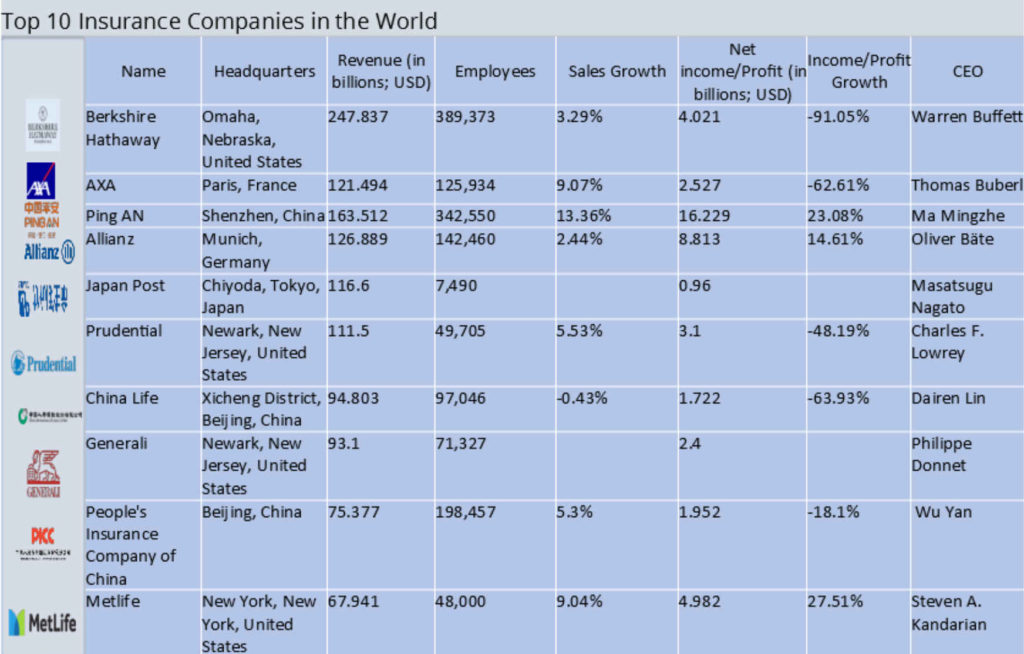
When people ask who belongs in the top three, size alone is not enough. The smarter question is this: which insurers are built to keep promises decades from now, even when claims surge, markets wobble, or catastrophes hit.
Financial strength ratings matter because insurance is a long-horizon product. A policy may sit quietly for years before you need a large payout, so an insurer’s balance sheet, capital reserves, and rating-agency profile directly shape policy security, claims-paying capacity, and long-term reliability. In broad market discussions, companies such as UnitedHealth Group, Elevance Health, and State Farm are often compared through measures like assets, premium volume, national scale, and ratings from agencies such as AM Best, S&P, and Moody’s.
The Balance Sheet Behind the Brand
Big numbers do not guarantee a better customer outcome, but they do reveal resilience. Large asset bases and premium volume can help insurers absorb shocks, invest in technology, diversify risk, and keep operations stable during expensive claim periods. That said, the strongest financial profile may still come with narrower pricing flexibility, slower service systems, or less appealing underwriting for certain buyers.
| Company | Financial Strength Indicator | Competitive Advantage | Consumer Relevance |
|---|---|---|---|
| UnitedHealth Group | Massive revenue base, broad operating scale, strong credit profile, major healthcare cash flow | Extraordinary scale and diversified health operations support capital strength | Signals durability for long-term health coverage and large claim obligations |
| Elevance Health | Large premium volume, national membership footprint, solid insurer ratings | Strong managed-care presence with substantial regional and employer-plan reach | Appeals to buyers who value financial depth in health-plan administration |
| State Farm | Very large asset base, major policy count, strong ratings, broad property-casualty reserves | Mutual structure and vast underwriting scale support claims capacity | Reassures auto and home policyholders who want dependable catastrophe response |
To read this table wisely, focus on what each metric actually signals before treating any brand as an automatic winner.
- Assets show the financial cushion available to support obligations, investment income, and reserve strength.
- Premium volume reflects market presence and recurring inflow, which can strengthen operating stability.
- Operating scale often means broader infrastructure, deeper analytics, and stronger disaster response capacity.
- Ratings condense expert judgment about capital adequacy and the insurer’s ability to pay claims under stress.
Financial superiority should still be separated from everyday value. An insurer can be exceptionally strong on paper yet feel expensive to budget-conscious households, especially if its underwriting model prices risk aggressively. Likewise, a giant carrier may have superior reserves but deliver an uneven experience through agent variability, network limitations, or slower issue resolution in complex cases.
Use financial strength as a confidence filter, not a standalone buying trigger. Once a company clears that filter, buyers should compare product fit, quote competitiveness, policy terms, and service consistency within the insurance category they actually need.
Pro Tip: If two insurers offer similar pricing, the one with stronger ratings and broader reserves often provides the safer long-term bet—especially for life, health, homeowners, or any policy where future claims could be large and unpredictable.
Review Customer Experience, Claims Handling, and Trust Factors
A big insurer can look unbeatable on paper yet feel frustrating when you actually need help. In real life, reputation is shaped not only by size, but by how fast, clear, and human the company feels when stress is high.
Customer experience matters because insurance is a promise tested under pressure. Buyers usually judge that promise through four signals: support accessibility, complaint frequency, claims speed, and policy clarity. If phone lines are hard to reach, claim updates are vague, billing errors drag on, or policy language feels slippery, trust drops fast. By contrast, insurers that explain coverage plainly, keep digital tools simple, and resolve claims with visible progress tend to earn stronger loyalty and referrals.
What Service Feels Like When the Stress Test Hits
Among commonly recognized leaders such as State Farm, GEICO, and Allstate, service style can feel very different even when all three are well known. State Farm often stands out for its large local agent network and more personal guidance, which can reassure buyers who want a familiar contact during claims or renewals. GEICO is frequently praised for streamlined online servicing and a strong mobile-first experience, making it attractive for people who prefer speed and self-service. Allstate typically blends digital tools with agent support, appealing to buyers who want both app convenience and human advice. Still, actual experience can vary by location, claim type, and the complexity of the loss.
| Provider | Mobile App Usability | Agent Network | Online Account Tools | Claims Assistance Style |
|---|---|---|---|---|
| State Farm | Solid and practical | Very strong local presence | Good for payments, documents, updates | Often more hands-on through agents |
| GEICO | Usually highly rated for ease | Limited compared with agent-heavy rivals | Strong self-service and quote management | Efficient, digital-first support model |
| Allstate | Feature-rich with broad account access | Strong national agent footprint | Robust policy and billing tools | Mixed model: digital updates plus agent help |
Before choosing, watch for service patterns that reveal whether the company is dependable only in advertising or dependable when life gets messy.
- Positive signal: claims status updates arrive proactively instead of only after repeated follow-ups.
- Positive signal: billing, endorsements, and ID cards are easy to manage through the app or web portal.
- Positive signal: policy documents explain exclusions, deductibles, and next steps in plain language.
- Negative signal: complaint trends repeatedly mention delayed callbacks, confusing denials, or payment disputes.
- Negative signal: customer support channels feel fragmented, with agents, adjusters, and billing teams giving different answers.
- Negative signal: claim help seems smooth for simple cases but becomes hard to navigate once damage is serious or unusual.
Dependability feels tangible. During emergencies, the right insurer is reachable fast, explains what happens next, and shows visible claim movement. During renewals, it presents price changes and coverage options clearly instead of hiding behind jargon. During billing disputes, it resolves errors with documented answers, fair timelines, and real accountability. That combination of clarity, consistency, and calm support is what makes an insurer feel trustworthy when it matters most.
Show How Rankings Change by Insurance Type and Buyer Needs
The “top three” is never fixed in real life. An insurer that shines for auto may fall behind for life, health, or small-business protection when your priorities shift.
That is why smart buyers compare insurers by use case, not popularity. Rankings move according to the policy type, pricing model, claims support, digital tools, network access, and the level of customization a buyer actually needs.
When the Best Choice Depends on the Life You Live
Different coverage categories reward different strengths. For auto, buyers often value competitive premiums, accident forgiveness, roadside help, and fast claims apps. For home insurance, the winning insurers may be those with stronger rebuilding coverage, water-damage options, and bundling discounts. Life insurance often favors carriers known for long-term financial durability, policy flexibility, and clear underwriting. Health coverage can elevate insurers with broad provider networks and prescription support, while travel insurance may favor brands with responsive emergency assistance. Business coverage often shifts rankings again, because owners need liability options, property protection, workers’ compensation, and industry-specific add-ons.
| Buyer Type | Insurance Need | Important Features | Best-Fit Insurer Traits |
|---|---|---|---|
| Families | Auto + home + life | Bundling, multi-driver support, child riders, strong claims service | Strong package discounts, dependable service, flexible family coverage |
| Seniors | Health, Medicare-related, travel, final-expense life | Provider access, simple policies, emergency assistance, stable premiums | Clear policy terms, broad networks, easy support channels |
| First-time drivers | Auto | Affordable rates, safe-driver tools, mobile app, deductible options | Usage-based pricing, education tools, strong discount programs |
| Homeowners | Home + liability | Dwelling limits, replacement cost, weather protection, quick inspections | Solid catastrophe handling, customizable property endorsements |
| Small business owners | General liability, property, commercial auto, workers’ comp | Scalable limits, industry riders, payroll integration, risk support | Commercial expertise, flexible policy design, responsive account service |
Use this table as a decision shortcut: the “best” insurer rises when its strengths line up with your daily risks. A first-time driver may rank an insurer first because of low-cost telematics, while a homeowner in a storm-prone area may rank another higher for superior property claims support and higher rebuilding protection.
Before you choose, pressure-test each offer with practical filters so the ranking reflects your wallet and your risk level, not just brand recognition.
- Check the total budget, including monthly premium, annual cost, fees, and how much bundling really saves.
- Review the deductible closely; a lower premium can hide a deductible that feels painful during a real claim.
- Compare coverage limits to your actual exposure, especially for liability, dwelling replacement, business interruption, or medical needs.
- Read exclusions carefully, such as flood, wear and tear, pre-existing conditions, rental use, or certain business activities.
- Ask about discounts for safe driving, home security, paperless billing, claim-free history, multi-policy bundles, or professional memberships.
Pro Tip: Request quotes using the same limits and deductibles from each insurer. That is the fastest way to see whether a company is truly a better fit or simply looks cheaper because the protection is thinner.
Build a Practical Framework for Choosing Among the Top Three
The smartest buyer does not ask, “Which big insurer is cheapest?” but “Which one protects me best when life gets expensive?” A practical framework turns brand recognition into a confident, evidence-based choice.
When three insurers all look strong on paper, the real difference appears in the fine print, optional add-ons, provider access, and the way claims are paid. Use a repeatable process so you compare the same protection level across each quote instead of being distracted by a lower premium that may hide weaker terms.
Your Side-by-Side Buying Blueprint
Start by standardizing the comparison. Ask each insurer for quotes based on the same deductible, liability limits, insured value, and optional protections. Then read beyond the headline premium: inspect policy wording, exclusions, endorsements, repair or hospital networks, waiting periods, depreciation rules, claim filing deadlines, and renewal conditions. This helps you measure true value, not just visible price.
Use this step-by-step process before you buy:
- Match the core coverage terms so every quote is built on the same assumptions.
- Read the base policy wording and mark exclusions that could affect your real-world risk.
- Check endorsements or riders that upgrade protection, limits, or eligibility.
- Review network access, including garages, hospitals, contractors, or digital claim support.
- Study claim terms such as documentation rules, payout method, settlement timeline, and sub-limits.
- Compare renewal behavior, including premium jump risk, non-renewal triggers, and discount durability.
Price matters, but price without protection is a false bargain. Features that should never be ignored include deductible size, sub-limits for common losses, exclusions for frequent risks, claim settlement basis, access to in-network providers, customer self-service tools, emergency support availability, and whether valuable endorsements cost extra. A policy that costs slightly more may deliver far better value if it reduces out-of-pocket exposure when a claim actually happens.
Pro Tip: Build a one-page comparison sheet and score each insurer line by line. If a quote looks dramatically cheaper, assume something is missing until proven otherwise.
| Comparison Step | What to Review | Why It Matters | Common Mistake to Avoid |
|---|---|---|---|
| Quote Matching | Limits, deductibles, insured value, optional benefits | Creates a fair apples-to-apples comparison | Comparing a low-limit quote to a high-limit quote |
| Policy Wording | Exclusions, waiting periods, definitions, sub-limits | Reveals what is not covered when loss occurs | Reading only the summary page |
| Endorsements | Riders for replacement cost, rental, accident forgiveness, critical add-ons | Shows whether the policy can fit your real needs | Assuming premium extras are included automatically |
| Claim Terms | Documentation, payout basis, repair choice, deadlines | Determines how smooth and adequate reimbursement may be | Ignoring claim restrictions until after purchase |
Before making the final pick, run this quick decision checklist:
- Can I afford the premium and the deductible if I need to claim soon?
- Does the policy cover my highest-probability and highest-cost risks with enough depth?
- Do I trust the insurer’s financial strength to keep paying claims over time?
- Is service convenient through strong networks, digital tools, and responsive support?
- Are renewal terms stable enough to avoid surprise repricing or shrinking benefits?
Closure

The top three insurance companies are not a fixed throne but a moving contest between strength, service, and fit. If you compare coverage with clear eyes and practical questions, the best insurer stops being the biggest name and becomes the one that protects your life with the least friction when it matters most.
FAQ
Who is usually named among the top three insurance companies?
Commonly recognized names include UnitedHealth Group, State Farm, and Allianz, though lists vary by category.
Why do rankings change between reports?
Because some reports prioritize size, while others focus on claims, satisfaction, or financial ratings.
Is the biggest insurer always the best?
No. Size helps stability, but service quality and policy fit matter just as much.
Which insurer is strongest for personal auto and home?
State Farm is often highly competitive for personal lines in the U.S.
Why do financial strength ratings matter?
They show an insurer’s ability to stay stable and pay claims over time.
What should buyers compare before purchasing?
Quotes, limits, deductibles, exclusions, endorsements, claims process, and renewal pricing.