Travel feels freer when your plans are protected, and John Hancock Gold Travel Insurance is built for travelers who want stronger support than a basic plan without stepping into top-tier pricing. It is often considered a balanced option for family vacations, cruises, prepaid tours, multi-stop itineraries, and both domestic and international trips where cancellation costs and medical surprises could become expensive fast.
The Gold plan usually appeals to travelers who want practical confidence: trip cancellation and interruption protection, emergency medical and evacuation support, baggage and delay benefits, plus access to travel assistance when disruptions turn stressful. In simple terms, it helps protect the money you prepaid and the risks you cannot easily control once the journey begins.





John Hancock Gold Travel Insurance Overview
John Hancock Gold Travel Insurance is the “sweet spot” plan for travelers who want more than bare-bones trip protection without paying for a top-tier package they may never fully use. It is built for people who value flexibility, prepaid trip security, and practical help when travel does not go as planned.
This plan is generally aimed at leisure travelers, families, couples, cruise passengers, and international tourists taking moderately priced to higher-value trips. Its core purpose is to help protect nonrefundable travel costs and reduce the financial shock of common disruptions such as trip cancellation, medical issues while away, delays, baggage problems, and emergency travel interruptions. For domestic and international itineraries alike, Gold is often chosen by travelers who want a balanced layer of protection around flights, hotels, tours, and transportation connections.
Where Gold Fits in the Travel Planning Sweet Spot
John Hancock Gold typically sits between entry-level and premium travel insurance options. Compared with budget plans, it usually offers broader trip-focused protection, stronger interruption support, and more useful travel assistance features for travelers with meaningful prepaid costs. Compared with premium plans, Gold is often positioned as a more cost-conscious choice for people who want solid, mid-range protection without chasing every high-limit upgrade or deluxe add-on.
Travelers often pick this plan because it matches real-world trips: family vacations with multiple bookings, cruises with strict cancellation rules, international journeys where medical access matters, and domestic trips where weather or airline disruptions can trigger extra expenses. Its appeal comes from practical balance—enough protection to feel prepared, without the price tag of a luxury-level policy.
| Benefit | What It Covers | Typical Limits | Who May Need It |
|---|---|---|---|
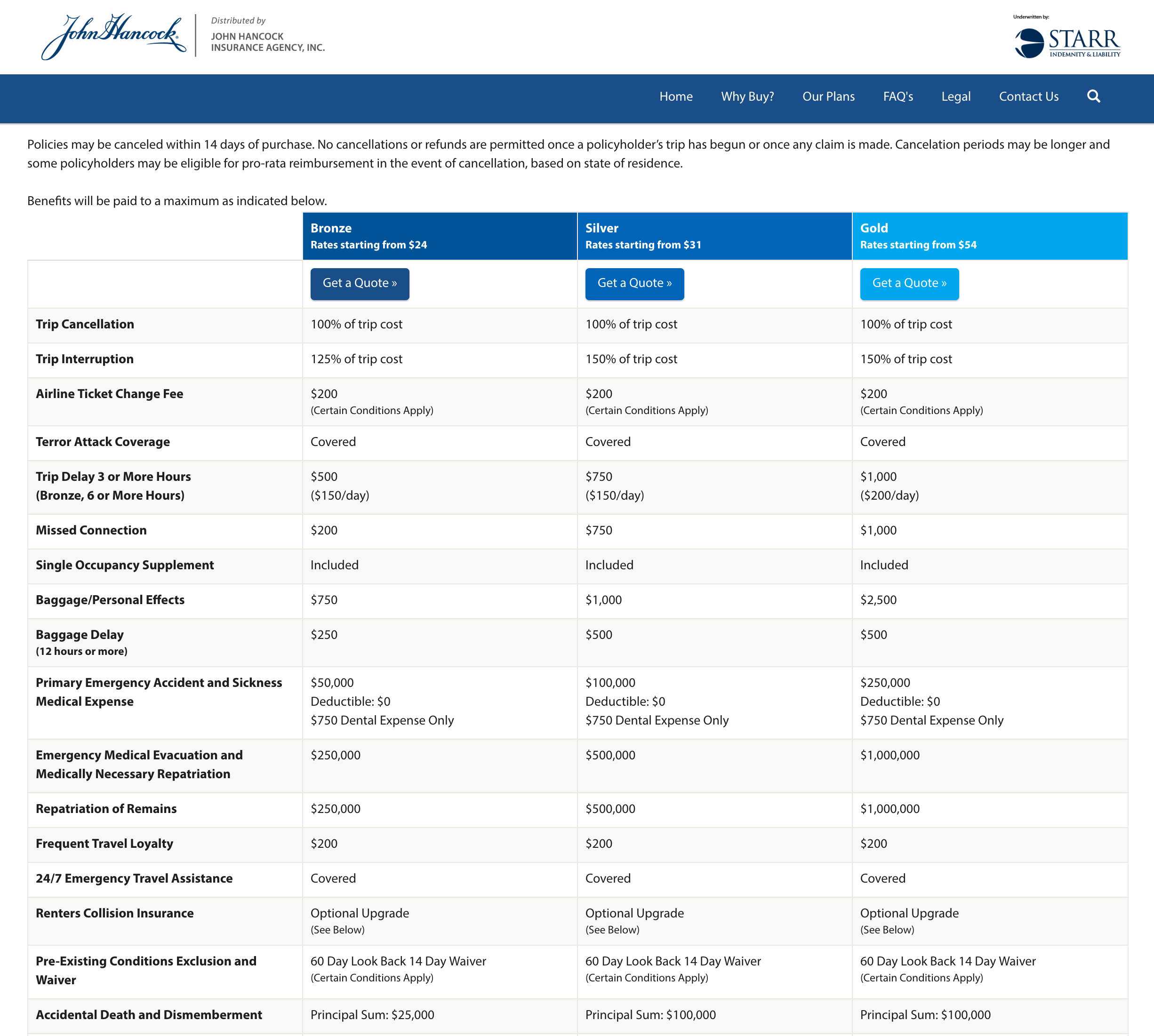
| Trip Cancellation | Nonrefundable prepaid trip costs if a covered event forces cancellation | Often up to 100% of insured trip cost | Families, cruise travelers, tour buyers |
| Trip Interruption | Unused trip expenses and extra transport home after a covered disruption | Often higher than cancellation, such as up to 150% | International and multi-stop travelers |
| Travel Delay | Meals, lodging, and essentials during covered delays | Varies by plan terms and delay length | Air travelers with connections |
| Emergency Medical / Evacuation | Covered urgent care abroad and emergency transportation when needed | Moderate to strong mid-tier limits | International travelers, older travelers |
| Baggage Protection | Lost, stolen, or delayed baggage and personal items | Subject to per-item and total caps | Cruise and flight-heavy itineraries |
Common reasons travelers choose Gold include protecting sizable prepaid bookings, creating a backup plan for unpredictable schedules, and gaining confidence before trips that involve multiple reservations or unfamiliar destinations.
Gold is often a smart fit for travelers such as:
- Family vacations with flights, hotels, and theme-park or resort deposits
- Cruises with port schedules, cabin payments, and missed-connection concerns
- Multi-stop itineraries where one disruption can affect the full route
- Prepaid guided tours with strict cancellation policies
- International leisure trips where medical support away from home matters
Pro Tip: Gold is often most compelling when your trip has several prepaid parts working together—because one delay, illness, or cancellation can create a domino effect in costs.
Coverage Details, Benefits, and Exclusions
John Hancock Gold Travel Insurance is strongest when you understand not just what it covers, but when those benefits actually activate. The difference between a smooth reimbursement and a denied claim often comes down to timing, wording, and documented cause.
Core protections usually include trip cancellation before departure, trip interruption after travel begins, emergency accident and sickness medical, emergency evacuation, baggage loss, baggage delay, and travel delay. Each benefit has a stated maximum, qualifying trigger, and exclusion list, so travelers should read the certificate carefully rather than assuming every disruption is automatically covered.
Trigger Rules That Quietly Decide Your Payout
Covered events generally involve sudden, unforeseen problems such as a serious illness, injury, certain severe weather disruptions, common carrier delays, or baggage mishandling by an airline. Non-covered events often include foreseeable problems, changing your mind, known storms before purchase, routine medical care, or supplier issues not named in the policy. Pre-existing condition treatment can be especially important: many plans offer a waiver only if you buy within a time-sensitive purchase window after your initial trip deposit and insure the full nonrefundable cost.
The chart below shows how coverage logic typically works in practice.
| Event | Covered Status | Notes | Traveler Impact |
|---|---|---|---|
| Doctor-certified illness before departure | Usually covered | Must be unforeseen and medically documented | Trip cancellation benefits may repay prepaid, nonrefundable costs |
| Illness during trip requiring return home | Usually covered | Can trigger trip interruption and medical benefits | May cover unused trip portions and extra transport home |
| Hurricane announced before policy purchase | Usually not covered | Known events are commonly excluded | Traveler may absorb cancellation loss |
| Airline loses checked bag | Usually covered | Subject to item limits and proof of loss | Reimbursement may be limited by per-item caps |
| Bag delayed for required number of hours | Usually covered | Delay must meet policy threshold | Can repay essential purchases like clothing or toiletries |
| Long carrier delay causing missed vacation time | Often covered | Must exceed minimum delay period | May reimburse meals, lodging, and local transport |
| Traveler cancels due to work stress or preference change | Usually not covered | Not a listed covered reason unless special upgrade applies | No standard cancellation reimbursement |
| Supplier financial default | Depends | May require coverage terms, timing, and eligible supplier type | Claim outcome can vary sharply by wording |
Eligibility can hinge on small but powerful rules. A pre-existing condition waiver may apply only if the plan is purchased soon after the first trip payment, the traveler is medically able to travel when buying, and no balance of the trip cost is left uninsured. Travel delay and baggage delay benefits also depend on specific triggers, such as a minimum number of delayed hours, receipts for necessary purchases, and confirmation from the carrier.
These examples show how reimbursement can change based on the exact trigger and limit.
- If you cancel a $4,000 tour after a covered pneumonia diagnosis, trip cancellation may reimburse the nonrefundable amount, minus any refunds already issued by the supplier.
- If a storm shuts down your connection for 12 hours and the policy delay threshold is met, travel delay benefits may repay hotel, meals, and local transportation up to the plan limit.
- If your suitcase arrives 24 hours late, baggage delay may cover emergency clothing and toiletries, but not luxury replacement shopping beyond the stated cap.
- If you cut a cruise short because of a covered injury, trip interruption may pay for unused prepaid arrangements and a reasonable additional flight home.
Pro Tip: For weather claims, the timing matters as much as the storm itself. If the event was foreseeable before you bought the policy, the claim may fail even when the disruption is real and expensive.
Policy wording and exclusions matter most in three areas: weather, where known-event language can block recovery; illness, where pre-existing condition rules and physician documentation are decisive; and supplier issues, where bankruptcy, strike, or service failure may be covered only under narrow definitions. In short, the Gold plan can be valuable, but claim success depends on matching your disruption to a listed covered reason and staying within the stated limits.
Pricing Factors and Plan Comparison
The price of John Hancock Gold Travel Insurance is not random; it rises or falls based on how much financial and medical risk your trip creates. The smartest comparison is not “Which plan is cheapest?” but “Which plan protects the most important parts of this trip without overspending?”
Five variables usually drive the premium most: traveler age, because older travelers often present higher medical risk; destination, since healthcare costs and travel disruption patterns differ by region; trip cost, because higher prepaid expenses increase the amount at risk for cancellation; trip length, as more travel days create more exposure to delays, illness, or baggage issues; and optional upgrades, such as rental car protection or extra cancellation flexibility. In practical terms, Gold often lands in the middle: more robust than a budget tier, but usually less expensive than a top-tier plan built for travelers who want maximum limits.
Smart Value Checkpoints
When comparing plan tiers, focus on how much protection you buy per dollar, not just the sticker price. Gold may deliver strong value for travelers who want balanced trip cancellation benefits and meaningful emergency medical support, while a lower tier may fit lighter trips and a higher tier may better serve expensive or medically sensitive itineraries.
| Feature | Bronze | Gold | Platinum |
|---|---|---|---|
| Typical pricing position | Lower cost | Mid-range | Higher cost |
| Trip cancellation value | Basic for smaller budgets | Balanced for moderate-to-high trip spend | Best for large prepaid investments |
| Medical protection strength | More limited | Stronger everyday protection | Highest cushion for major events |
| Best fit | Short, lower-cost trips | Families, international travelers, multi-part trips | Luxury, long-haul, or high-risk plans |
To judge value beyond price, weigh three things together: coverage limits for what you could lose financially, medical protection for where you are going, and cancellation flexibility for how uncertain your plans feel. A slightly higher premium can be the better buy if it meaningfully expands reimbursement for trip interruption or protects against costly overseas treatment.
Use this quick scenario guide to test whether Gold fits your travel style.
- Couple on a $4,500 international vacation: Gold may be suitable because the trip cost is meaningful and medical backup matters abroad.
- Solo traveler on a cheap domestic weekend: Gold may be excessive if prepaid costs are low and the itinerary is simple.
- Family with connecting flights, cruises, or tours: Gold may be suitable because more moving parts create more interruption and cancellation risk.
- Traveler with a very expensive once-in-a-lifetime itinerary: Gold may be insufficient if higher-tier limits better match the investment.
- Older traveler prioritizing stronger medical reassurance: Gold may be suitable, though some may prefer a higher tier if they want the broadest cushion.
For a fast cost-value framework, compare your trip using these steps before choosing a tier.
- Calculate your total prepaid, nonrefundable trip investment.
- Estimate your biggest risk: cancellation loss, medical emergency, or travel disruption.
- Match that risk to the plan tier whose limits feel proportionate, not merely affordable.
- Add optional benefits only if they solve a real exposure, not just a hypothetical worry.
Pro Tip: If your trip cost is moderate but your destination has expensive healthcare, Gold can outperform a cheaper plan on real-world value even when the premium looks higher at checkout.
Claims Process, Documentation, and Reimbursement Steps
When travel goes sideways, a fast, organized claim can make the difference between a smooth payout and a frustrating delay. With John Hancock Gold Travel Insurance, the smartest move is to treat every incident like a paper trail starts the moment it happens.
The process is straightforward: report the event, gather proof, submit the claim, respond quickly to follow-up requests, and track reimbursement until payment is issued. The insurer reviews whether the loss matches a covered reason, whether documents support the amount claimed, and whether filing deadlines and policy terms were followed.
Smart Claim Filing Playbook
Use this step-by-step sequence to keep your claim moving. The goal is clear evidence, complete forms, and fast communication so the reviewer does not need to pause your file for missing details.
- At the time of the incident: get medical care, airline confirmation, police reports, or supplier notices right away.
- Notify the right party: contact the travel provider, airline, hospital, or emergency assistance line as soon as practical.
- Save everything: keep receipts, invoices, boarding passes, itineraries, baggage reports, and written cancellation notices.
- Open the claim: file through the insurer’s claims portal or claim form, using your policy number and incident date.
- Upload documents: submit legible copies, not blurry screenshots or partial pages.
- Answer follow-ups quickly: if adjusters request more proof, respond promptly to avoid the file going inactive.
- Track reimbursement: monitor claim status and keep copies of every submission and email.
Different claim types require different proof. Prepare documents by category before you submit.
- Medical claims: itemized bills, diagnosis notes, treatment records, prescriptions, payment receipts, and proof of travel dates.
- Trip cancellation/interruption claims: booking invoices, cancellation penalties, physician statement if illness is involved, supplier cancellation notice, and proof of the covered reason.
- Baggage loss/damage claims: airline or carrier report, baggage claim tags, list of lost items, repair or replacement estimates, and photos if available.
- Travel delay claims: carrier delay statement, updated itinerary, receipts for meals/lodging/transport, and evidence showing the delay length.
| Claim Type | Required Documents | Filing Tips | Common Mistakes to Avoid |
|---|---|---|---|
| Medical | Bills, records, doctor notes, receipts | Request itemized invoices before leaving care | Submitting only credit card slips |
| Cancellation | Trip invoices, penalties, supplier notice, proof of cause | Match dates across all documents | Missing proof that the reason was covered |
| Baggage | Carrier report, tags, item list, estimates, photos | Report loss to airline immediately | No official carrier report number |
| Delay | Delay letter, receipts, itinerary | Keep every small expense receipt | No written proof of delay duration |
Timelines matter. File as soon as possible after the incident, because delays can make verification harder and may trigger extra scrutiny. Strong claims usually include dated proof, official third-party documents, and receipts that match the traveler’s name and trip details. Communication also speeds review: use one claim number on every message, reply in full rather than piecemeal, and confirm when additional files were received.
Pro tip: Create one digital folder for your policy, receipts, reports, and emails before you travel. That single habit can shave days off claim preparation if something goes wrong.
Claims are often delayed or denied for practical reasons: incomplete forms, unreadable files, excluded events, late notice, no proof from the airline or doctor, or expenses that do not qualify under the policy. Prevent these problems by reading the policy wording, documenting the event immediately, filing within stated deadlines, and double-checking that every claimed amount is supported by a matching receipt or formal report.
Customer Experience, Strengths, and Limitations
For many travelers, insurance only feels valuable when it is easy to buy, easy to understand, and steady under pressure. John Hancock Gold Travel Insurance tends to appeal to people who want practical protection without turning trip planning into paperwork.
Customer experience often comes down to four priorities: a smooth purchase path, benefits that feel understandable at a glance, responsive support when plans unravel, and real confidence during a medical or travel emergency. In that context, the Gold plan can feel like a strong middle ground: more reassuring than bare-bones coverage, yet not always as expansive as travelers with very high trip costs, complex medical concerns, or adventure-heavy itineraries may prefer.
What the Plan Feels Like When Real Life Happens
The Gold plan’s biggest advantage is usability. Travelers often value being able to compare options quickly, confirm core protections, and travel with the comfort of assistance services in the background. That said, confidence should come from matching the plan to the trip, not from assuming every disruption or expense will be covered at the highest level.
| Category | Strengths | Limitations | Best-Fit Traveler |
|---|---|---|---|
| Purchase Experience | Usually straightforward for travelers who want quick enrollment and a recognizable insurer. | Fine-print review is still essential, especially for benefit caps, timing rules, and exclusions. | Busy vacationers who want efficient setup. |
| Benefit Clarity | Gold commonly feels easier to grasp than highly customized premium plans. | Some travelers may still find emergency, delay, and medical language too technical without careful reading. | People seeking balanced, mid-tier protection. |
| Support and Assistance | Emergency assistance features can add peace of mind during disruptions, illness, or document loss. | Response quality can vary by situation, time zone, and the completeness of traveler documentation. | International travelers who want backup coordination. |
| Overall Protection Scope | Often well-suited for common trip risks rather than only catastrophic events. | Travelers with luxury itineraries or specialized activities may want broader or higher-limit coverage. | Couples, families, and standard leisure travelers. |
Where traveler support matters most is often outside reimbursement itself. Assistance features may help coordinate emergency medical referrals, guide travelers after a passport or document loss, and provide direction when flights are canceled or connections collapse. That operational help can be just as important as the policy benefits, because during a stressful event, knowing who to call and what to do next saves time, money, and emotional energy.
Here are realistic scenarios that show where the Gold plan may shine and where some travelers may want more:
- A family flying to Europe faces a long delay and extra meal costs; Gold can feel valuable when routine disruption protection matters more than ultra-premium extras.
- A traveler gets sick abroad and needs help locating care; emergency assistance services can strengthen confidence even before any claim is filed.
- A couple loses passports before a return flight; support with document guidance can reduce panic and speed up problem-solving.
- A luxury traveler with a very expensive prepaid itinerary may find Gold less ideal if higher reimbursement ceilings are a priority.
- An adventure-focused traveler may need broader protection if the trip includes riskier activities or more specialized medical exposure.
Practical traveler note: Before purchasing, check whether the plan’s limits match your total prepaid trip cost, review exclusions tied to activities or medical history, and save the emergency assistance contact details where you can access them offline.
How to Choose and Use the Plan Effectively
The smartest travel insurance choice happens before you click “buy.” John Hancock Gold works best when you match the plan to your trip’s real pressure points, not just the ticket price.
Start by looking at what would hurt most if the trip went sideways: losing nonrefundable payments, needing treatment far from home, or getting delayed in a place where costs rise fast. A short domestic city break may need lighter scrutiny than an international itinerary with multiple flights, cruises, tours, or remote stops. If you have ongoing medical concerns, expensive prepaid bookings, or a destination with limited healthcare access, review the Gold plan with extra care so the protection fits the trip instead of merely sounding reassuring.
Smart Fit Check Before You Buy
Before selecting the plan, weigh three practical questions: What can you lose financially? What medical help might you realistically need? and How hard would it be to recover from delays or interruptions? For cancellation exposure, total every prepaid, nonrefundable cost such as flights, hotels, tours, cruise deposits, and event tickets. For medical needs, consider age, prescription requirements, mobility issues, and whether your regular health insurance offers meaningful out-of-network or overseas support. For trip risk, think about weather season, connection complexity, supplier stability, and whether your destination is known for transport disruptions or high emergency care costs.
Use this checklist before purchase so your decision is grounded in facts rather than guesswork:
- Destination: Is healthcare expensive, limited, remote, or difficult to access quickly?
- Health concerns: Do you have ongoing conditions, important medications, or a need for faster medical coordination?
- Activities: Are you planning adventure excursions, water sports, or higher-risk experiences that may need special review?
- Supplier refund policies: Will airlines, cruise lines, tour operators, or rentals offer credits, partial refunds, or nothing at all?
- Total prepaid expenses: Have you added every nonrefundable cost instead of insuring only the airfare?
Once the trip profile is clear, inspect the certificate carefully. Read the benefit descriptions, exclusions, definitions, and time-sensitive provisions line by line. Verify cancellation and interruption limits against your actual prepaid costs, confirm medical and evacuation amounts feel realistic for your destination, and check whether optional upgrades are available for concerns like rental cars or broader cancellation flexibility. If a feature matters to you, do not assume it is included by default—confirm it before payment.
| Traveler Type | Top Concern | Recommended Focus | Caution Point |
|---|---|---|---|
| Family traveler | Cancellation losses | Match coverage to full prepaid trip cost | Do not forget tours and park packages |
| Senior traveler | Medical support | Review medical and evacuation limits closely | Check exclusions and timing rules carefully |
| Cruise traveler | Interruptions and delays | Read missed-connection and interruption terms | Supplier credits may reduce claim value |
| Adventure-focused traveler | Activity-related incidents | Verify activity fit and assistance access | Do not assume every excursion is covered |
After purchase, use the plan like a disciplined record keeper. Save booking confirmations, invoices, receipts, medical reports, delay notices, baggage reports, and any written communication from airlines, hotels, or tour operators. If trouble starts, contact the plan’s assistance services early, especially for medical events, major interruptions, or situations where coordinated help could affect reimbursement or care logistics. Strong documentation turns a stressful event into a manageable claim trail.
- Store digital and paper copies of policy details, emergency contacts, and receipts.
- Ask every provider for written proof of delays, cancellations, extra expenses, or treatment.
- Take photos or screenshots of disruption notices, luggage issues, and rebooking costs.
- Record names, dates, and times when speaking with assistance teams or travel suppliers.
- Keep unused ticket values and refund responses documented to avoid claim gaps.
Pro Tip: The best policy users are proactive, not reactive. Review the certificate before purchase, then travel as if you may need to prove every extra dollar later.
Final Summary

John Hancock Gold Travel Insurance can be a smart middle-ground choice when your trip has real financial exposure and you want meaningful protection without automatically paying for the highest level available. Read the certificate carefully, confirm limits, check time-sensitive rules, and match the plan to your destination, health needs, and refund risks. When chosen wisely and used carefully, this plan can turn uncertainty into calm, and that peace of mind is often the most valuable part of the purchase.
FAQ
What is John Hancock Gold Travel Insurance best for?
It is best for travelers who want mid-tier protection for prepaid trips, medical emergencies, delays, and baggage issues.
Does the Gold plan cover trip cancellation?
Yes, for covered reasons listed in the policy, such as certain illnesses, severe weather, or other eligible disruptions.
Are pre-existing conditions automatically covered?
Not always. Coverage may depend on a waiver, timely purchase, and meeting all eligibility rules in the certificate.
Is this plan good for international travel?
Often yes, especially when you want emergency medical, evacuation, and travel assistance beyond what basic trip protection offers.
What can delay or deny a claim?
Missing documents, late filing, excluded events, lack of receipts, or misunderstanding policy triggers are common reasons.
How do travelers use the plan effectively?
Keep receipts, report issues quickly, contact assistance when needed, and document cancellations, delays, and medical events thoroughly.